

I’ve been watching Shopify’s moves toward agentic commerce for the past month. The more I read about their Universal Commerce Protocol and Agentic Plan, the clearer one thing becomes:
Most Shopify Plus stores are not architecturally ready for this.
Not because merchants are doing anything wrong. But because the way we’ve been building Shopify themes for the past decade—visual-first, human-browseable, Liquid-heavy—is fundamentally incompatible with how AI agents need to consume commerce data.
I’ve spent the last two weeks deep in Shopify’s engineering blog, the UCP specifications, and Google’s developer documentation. Testing approaches, building proof-of-concepts, rethinking patterns I’ve used for years.
Here’s what I’m seeing, and why I’m changing how I architect Shopify stores starting now.
The Problem: AI Agents Don’t Browse, They Query
Think about how humans shop on a Shopify store. They see visual badges, read marketing copy, browse product images. When we use Liquid to conditionally show “Free Shipping” or “Limited Edition,” it works perfectly for them.
But AI agents can’t see your theme. They don’t render your Liquid templates. They query structured data.
When ChatGPT or Google Gemini asks, “Does this ship for free?” or “Is this compatible with X?”—if that logic only exists in a Liquid {% if %} statement, the agent gets nothing.
Your store might be connected to UCP, but if your data isn’t semantically structured, you’re invisible anyway.
What Most Developers Will Get Wrong
I see this playing out in two ways:
The “Wait and See” Approach:
Some developers will assume Shopify handles this automatically. They’ll enable Agentic Storefronts, wait for traffic, and wonder why nothing happens. UCP provides the handshake—but you’re responsible for what goes inside it.
The “JSON-LD is Enough” Approach:
Others will add basic JSON-LD schema and call it done. Better than nothing, but not enough. If your business logic, shipping rules, compatibility requirements, and product relationships aren’t explicitly structured, AI agents will skip your products entirely.
Here’s the shift I’m making: Logic as Data, Not Code.
The Architecture: Stop Hiding Logic in Liquid
The core anti-pattern I see everywhere (including in code I’ve written):
The Old Way (Logic in View Layer):
{% comment %}
  PROBLEM: This rule only exists in the template.
  An AI agent via UCP has zero visibility into this logic.
{% endcomment %}

{% if product.price > 5000 and product.tags contains 'free-ship' %}
  <span class="badge">Free Shipping</span>
{% endif %}
The Protocol-First Way:
{% comment %}
  SOLUTION: The decision is pre-computed and stored as data.
  Now accessible to both the theme AND any AI agent via API.
{% endcomment %}

{% if product.metafields.sales.is_free_shipping.value == true %}
   <span class="badge">Free Shipping</span>
{% endif %}
The difference? is_free_shipping is now a boolean metafield, not a runtime calculation. We use Shopify Flow (or scripting) to compute it when the product is saved. The Liquid becomes dumb—it just renders the truth.
This single pattern change makes your business logic:
- Accessible via Storefront API
- Available to AI agents through UCP
- Testable and auditable
- Maintainable long-term
Implementation: Structured Data Everywhere
We can’t fully deploy UCP ourselves yet—it’s being rolled out through partnerships with Google, Microsoft, OpenAI. But JSON-LD is the closest proxy we have right now, and it reveals whether your data architecture is ready.
Here’s a production-ready snippet I’m using in new projects:
{% comment %}
components/json-ld-agentic.liquid
Strict schema generator pulling from structured metafields
{% endcomment %}
<script type="application/ld+json">
{
"@context": "http://schema.org/",
"@type": "Product",
"name": {{ product.title | json }},
"description": {{ product.description | strip_html | json }},
{% comment %}
CRITICAL: Expose "soft" attributes as hard data.
AI agents scan these keys to answer questions like:
"Is this cotton?" "Does it fit X?" "Will it ship to Y?"
{% endcomment %}
"material": {{ product.metafields.specs.material | json }},
"size": {{ product.metafields.specs.dimensions | json }},
"pattern": {{ product.metafields.specs.pattern | json }},
"offers": {
"@type": "Offer",
"priceCurrency": {{ shop.currency | json }},
"price": {{ product.price | divided_by: 100.00 | json }},
"availability": "http://schema.org/{% if product.available %}InStock{% else %}OutOfStock{% endif %}",
{% comment %}
Our pre-calculated shipping logic from metafields.
Default filter ensures code never breaks if data is missing.
{% endcomment %}
"shippingDetails": {
"@type": "OfferShippingDetails",
"shippingRate": {
"@type": "MonetaryAmount",
"value": {{ product.metafields.sales.shipping_cost.value | default: 9.99 }},
"currency": {{ shop.currency | json }}
}
}
}
}
</script>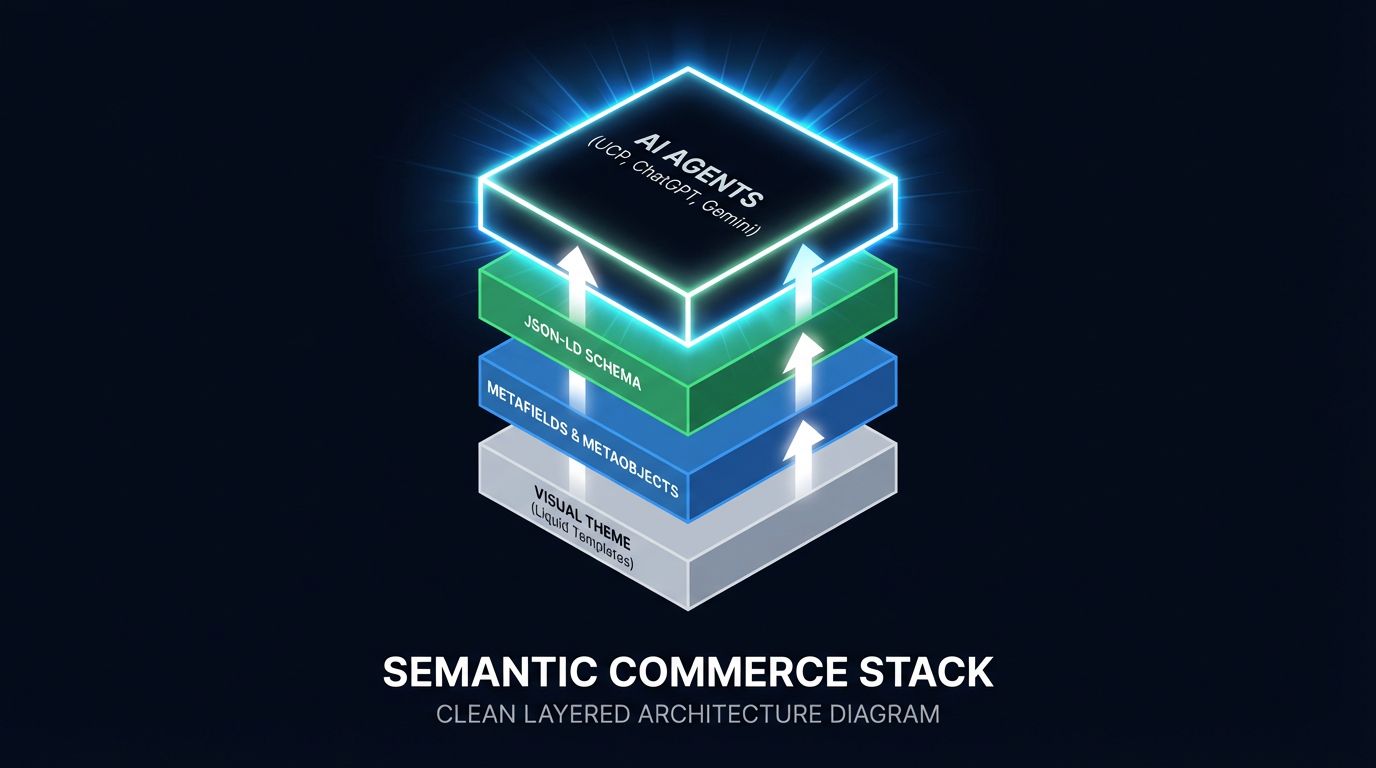 Screenshot: The semantic commerce stack: from visual templates to AI-readable structured data.
What This Means for Metafields & Metaobjects
I’ve been using metafields heavily for years—they’re essential for any complex Plus build. But UCP changes how we need to think about them.
You can’t just use metafields for theme customization anymore. In a UCP-ready architecture:
- Metafields must be semantically meaningful, not just cosmetic
- Metaobjects define strict entity types that AI agents can understand (Materials, Designers, Certifications)
- Business logic lives in queryable data, not just template code
Example: I’ve always used metafields for product specs. But now, instead of a loose “custom_attributes” text field displayed in the theme, I’m creating structured metafield definitions with proper types—and ensuring they map to Schema.org properties that AI agents expect.
Instead of hardcoding product compatibility in Liquid, create a Metaobject for “Compatible Devices” and reference it from products. Now AI agents can traverse those relationships programmatically.
The Methodology I’m Developing
Here’s the three-phase approach I’m building based on the UCP specs and Shopify’s engineering documentation:
Phase 1: Data Audit
Identify where business logic currently lives. Is it in Liquid? In app code? In manual merchandising? Map what needs to become structured data.
Phase 2: Schema Migration
Define metafield definitions and Metaobjects for:
- Product attributes (material, dimensions, compatibility)
- Shipping logic (free shipping eligibility, delivery windows)
- Availability rules (market restrictions, pre-order status)
- Relationships (complementary products, required accessories)
Use Shopify Flow or custom scripting to compute these values automatically.
Phase 3: JSON-LD Implementation
Build strict schema templates that pull from structured metafields. Validate against Schema.org and test with Google’s Rich Results tool.
When UCP becomes widely available, these stores will be ready—not scrambling to refactor.
Why I’m Doing This Now
Honest answer? I can’t afford to be late to this.
Agentic commerce is already happening. Shopify merchants are selling through ChatGPT, Copilot, and Google AI Mode right now. The UCP announcement isn’t a future vision—it’s infrastructure for what’s already starting.
If I wait until clients ask for “AI readiness,” I’ll be six months behind developers who saw this coming.
More importantly: stores that aren’t semantically structured won’t just rank lower in AI recommendations—they won’t appear at all. AI agents don’t have a page 2. If your data is messy, you’re invisible.
The Real Risk
Here’s what keeps me up at night: Most Shopify Plus agencies will treat this as a checkbox feature. “UCP integration” will become a line item. Stores will get “connected” without being architecturally ready.
And merchants will wonder why they’re not seeing traffic.
The gap between “UCP-connected” and “UCP-ready” is massive. Shopify provides the protocol. We provide the data architecture.
If your product catalog was built for human browsing—not machine querying—you have work to do. That includes stores I’ve built. It probably includes stores you’ve built.
Conclusion
Shopify’s Universal Commerce Protocol isn’t a feature you enable. It’s an architectural constraint you design for.
In 12-18 months, AI agents will drive meaningful e-commerce traffic. The stores winning that traffic will be the ones that made their business logic queryable, their product data semantically rich, and their checkout flows programmatically accessible.
The question isn’t whether this matters. It’s whether you’ll adapt before your competitors do.
I’m starting now. Not because I have all the answers, but because waiting until UCP is “fully rolled out” means you’re already late.
Thinking about UCP readiness for your Shopify store? Let’s talk about what this shift means for your specific setup.