

I’ll be honest: I haven’t implemented a full Agentic Storefront for a DTAILS client yet. It’s too new. Shopify only announced it at Winter Editions ‘26 last week.
But I’ve spent the last few days digging into the documentation and the new Dev Dashboard, and I realized something: Agentic Storefronts aren’t an AI revolution—they’re a technical debt accountability check.
For years, we’ve built Plus stores under the assumption that a human is the final consumer. We used beautiful hero banners to hide messy descriptions and JavaScript workarounds to fix broken variant logic after the page loaded.
Agentic commerce—where ChatGPT, Copilot, or Perplexity reads your store to make a sale—strips all that away. AI doesn’t see your pixels. It only sees your data.
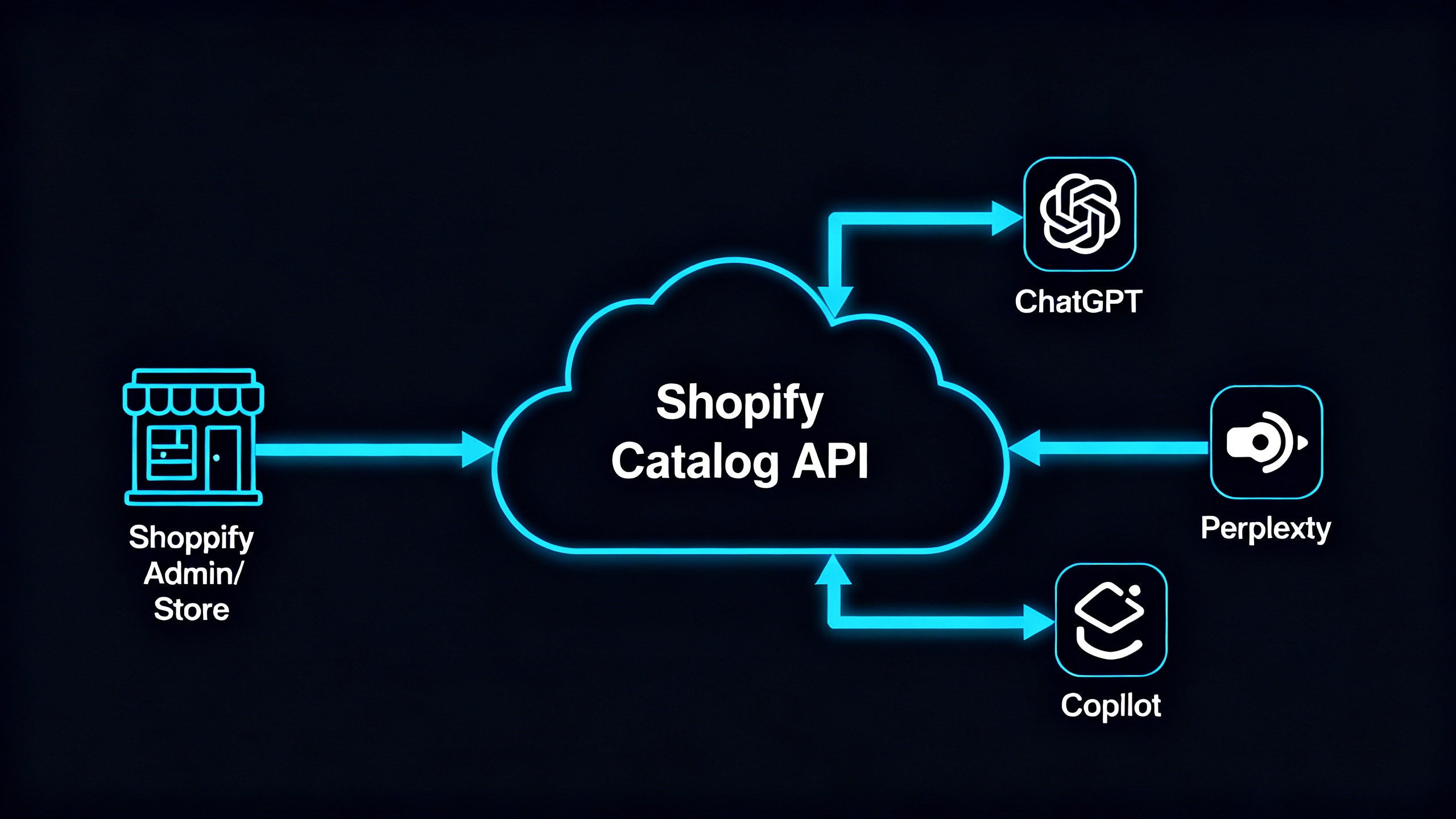 Screenshot: Architecture diagram showing how Shopify Catalog API centralizes data distribution, replacing bespoke integrations for every AI platform.
Why This Architecture Changes the Math
This shift means one data standard replaces $15k–$20k/year in custom multi-platform integration costs. Shopify becomes the middleware, letting us shift budget from repetitive channel coding to product data enrichment.
The setup cost is lower, but the entry requirement is higher data integrity.
The Semantic Collapse
I’ve seen plenty of Plus stores that look amazing but collapse semantically. Product titles that rely on visual context to make sense, or technical specs buried in unstructured HTML blocks, don’t work here.
If a user asks an AI assistant for “Fair-trade organic coffee beans under $30,” and your data isn’t structured to confirm those specific attributes, you simply don’t exist in the results. There’s no “404 Error” in the chat window. Just absence.
Here’s what gets expensive: you’re paying for search clicks while your competitors get zero-cost recommendations because their data was machine-readable.
Data Architecture as the New UX
At DTAILS, we focus on UX Engineering. Usually, that means micro-interactions, accessibility, and performance. But in 2025, product data structure is a UX problem.
If I can’t explain a product’s value through a layout, I have to explain it through Metafields. I’m looking at our Admin implementations differently now. We need to design Metafield schemas that make it impossible for merchandising teams to leave data unstructured.
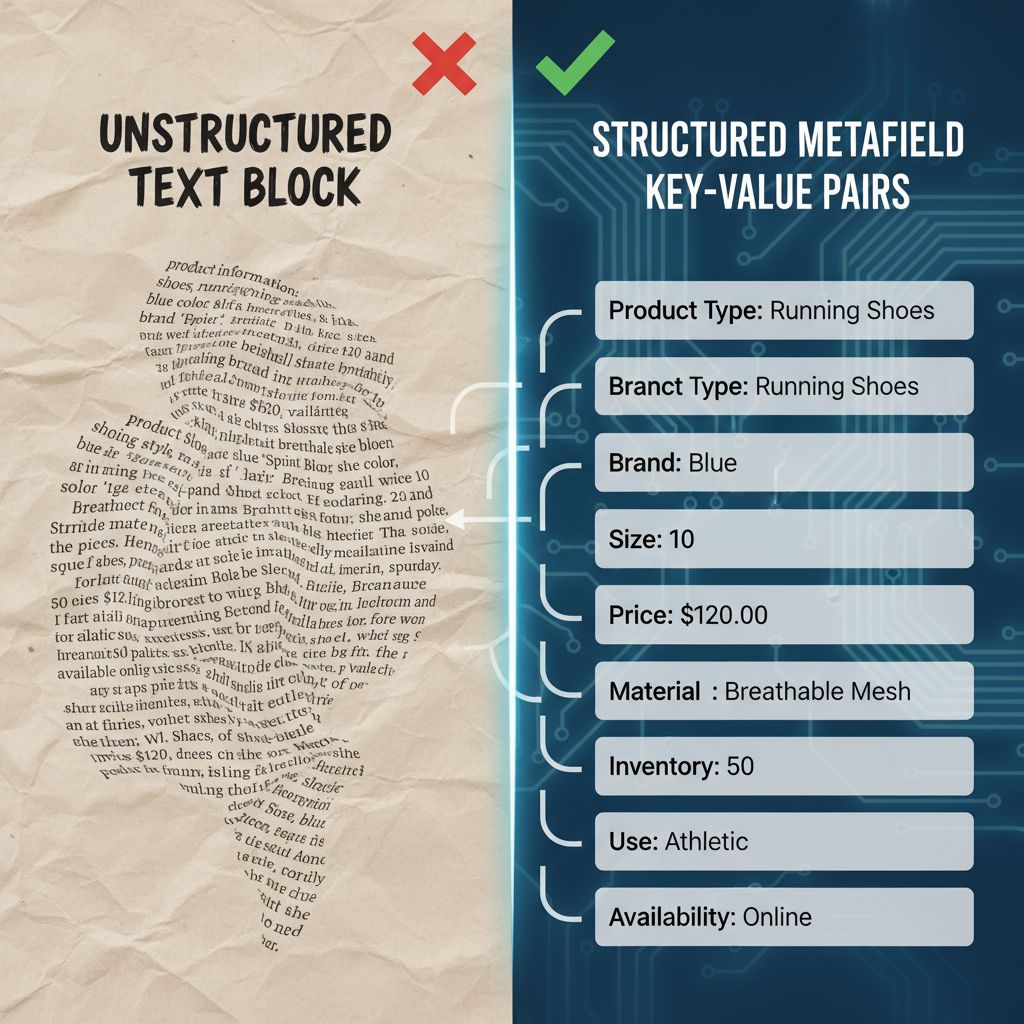 Screenshot: Visual comparison: AI agents struggle with vague descriptions but thrive on clean, validated Metafield key-value pairs.
Here’s what an AI-ready metafield definition looks like:
{
  "namespace": "custom",
  "key": "material",
  "type": "single_line_text_field",
  "name": "Material Composition",
  "description": "Specific material (e.g., '100% organic cotton', not 'high quality')",
  "validations": [
    {
      "name": "min_length",
      "value": "10"
    }
  ]
}
The validation forces specificity. “High quality” fails. “100% GOTS-certified organic cotton” passes.
This is frontend work. Building the admin interfaces that enforce data quality at the point of entry, not after the fact.
The Checkout Extensibility Gate
There’s a massive technical hurdle many Plus merchants are ignoring: Checkout Extensibility. The Agentic flow uses the new Checkout Kit to handle transactions inside the chat window.
This kit is the final nail in the coffin for legacy checkout.liquid files. If a store hasn’t migrated, they’re locked out of the AI purchase flow.
My priority for our clients right now isn’t “AI features”—it’s ensuring the frontend foundation is modern enough to actually let an AI agent complete a sale.
The Technical Reality
The Catalog API implementation is surprisingly clean. It’s not about Liquid hacks—it’s about standardized REST patterns. Here’s what the search query looks like:
// Example from Shopify Catalog API documentation
const params = new URLSearchParams({
  query: 'sustainable running shoes',
  ships_to: 'DK',
  available_for_sale: 1,
  min_price: 80,
  max_price: 150
});

const response = await fetch(
  `https://discover.shopifyapps.com/global/v1/search?${params}`,
  {
    headers: {
      'Authorization': `Bearer ${token}`
    }
  }
);
Every parameter here is a quality gate. If your inventory isn’t accurate or your pricing is out of sync, the AI skips your store entirely.
 Screenshot: The search logic. Every parameter tests your data quality. Fail any test and you’re invisible.
What I’m Focused On
I don’t have all the answers yet. I’m still figuring out how we’ll handle brand voice in text-only environments and how attribution will shift when conversions happen outside your domain.
But I know this: the stores that figure this out early won’t be the ones with the flashiest websites. They’ll be the ones whose data still makes sense when there’s nobody there to explain it.
I’ll write a proper implementation guide once I’ve shipped this for a real project. For now, I’m focused on getting our clients’ data ready for what’s coming.
If you’re working on this already, I’d be curious what you’ve learned. What surprised you? Where are you spending the most time?